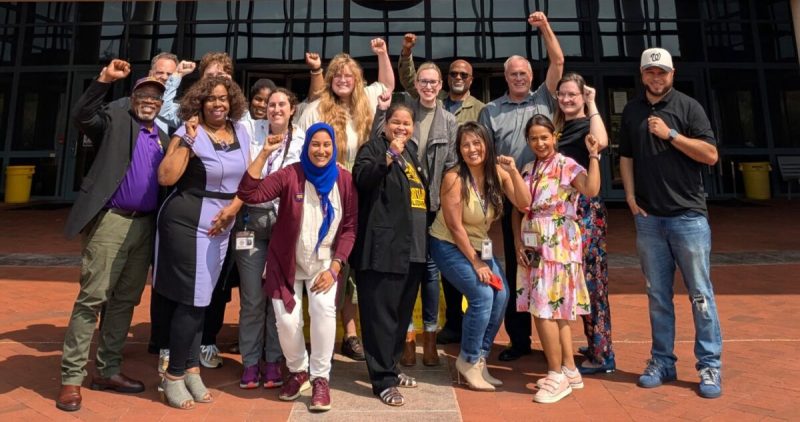
Thousands of Fairfax County government employees will soon vote on whether to ratify their first union contract.
Thousands of local government employees are on the cusp of finalizing their first union contract.
Service Employees International Union Virginia (SEIU) 512 and Fairfax County have reached a tentative deal on a three-year collective bargaining agreement that would cover about 11,600 general county employees, including park employees, library employees, public works employees, and more.
The union is meeting with members across Fairfax County to let them know about the pay increases, higher salary range maximums, protected telework policy, and other items in the tentative agreement before they vote on whether to ratify the contract in October.
There is a great deal of excitement among the Fairfax County employees about the new agreement and the protections it would put in place, according to Tammie Wondong, a social worker who’s worked for the county for more than three decades.
“These are things that we have hoped for through the years,” Wondong said in an interview ”And it’s finally here.”
In addition to pay and benefits protections, the tentative agreement creates a way for employees who speak multiple languages that help them do their jobs be compensated for those skills. The tentative agreement also includes language to create labor management committees to foster better communication between labor and management.
“Frontline employees will actually get an opportunity to sit down with the managers, the decision makers, to talk about ways to improve their day-to-day work environment,” said LaNoral Thomas, president of SEIU Virginia 512.
The tentative agreement is a milestone for Virginia’s labor movement after decades of work to overturn the ban on collective bargaining for local government employees.
Fairfax passed an ordinance in 2023 that gave local county employees the right to collectively bargain. That ordinance was only possible because former Democratic Gov. Ralph Northam in 2020 signed legislation lifting a complete ban on collective bargaining for some public employees.
The law made it so local government and school board employees could collectively bargain if ordinances or resolutions were passed at the local level allowing them to do so.
Looking ahead, labor leaders and some Democrats are backing more comprehensive legislation that would allow all public sector employees the right to collectively bargain without needing approval at the local level. A version of this kind of legislation was vetoed by Republican Gov. Glenn Youngkin earlier this year.
“This contract is yet another example of what happens when workers are united,” Thomas said in an interview. “We look forward to the election in November and then the 2026 legislative session to expand collective bargaining.”