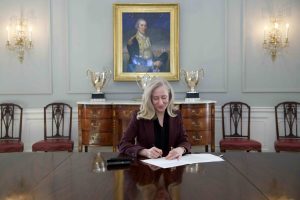
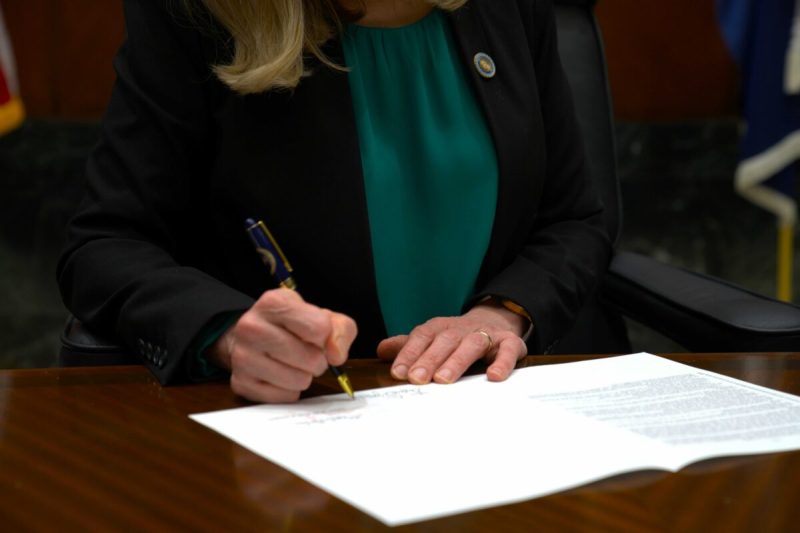
Gov. Abigail Spanberger (D) is proposing changes to the public-sector collective bargaining bill that Democratic Senate Majority Leader Scott Surovell says weakens the bill’s protections for workers.
Democratic Senate Majority Leader Scott Surovell and a large state union are not happy with changes Gov. Abigail Spanberger (D) wants to make to legislation that would lift the ban on public-sector collective bargaining.
In a midnight press release, Spanberger’s office announced the governor was proposing a new version of the legislation to lift the state ban on collective bargaining for public employees.
While short on details explaining the proposed changes, the governor’s press release stated the proposed changes would give localities “flexibility” to work with a new state board the legislation would establish “to set up bargaining in a way that makes sense for their communities.”
“My amendments are about making sure that when these laws take effect, they work — for workers, for businesses, and for the localities and the Commonwealth that will implement them,” Spanberger said in the release.
Surovell, who carried the bill in the Senate, saw the final version of her proposed substitute on Tuesday morning when it was made public and at first glance he wasn’t happy with the changes.
“I’m very disappointed,” Surovell told Dogwood in an interview.
Surovell identified 25 changes proposed by Spanberger that add up to, in his view, a bill that is weaker for workers.
The biggest change is that Spanberger wants implementation of the bill for localities to be pushed back to 2030, Surovell said. The version passed by the General Assembly called for the legislation to go into effect in 2028 for local governments and school boards.
On a virtual press call, Spanberger said state employees would be able to collectively bargain first, and that the extra time for local governments allows time for any adjustments that might be needed.
“I thought it was best to make sure that certainly, as the head of the executive branch, to have us take that step forward, learn from any of the hurdles that might be in our way, and set localities up for success,” Spanberger said.
Surovell said Spanberger’s proposed changes loosen up the statutory requirements around collective bargaining and would leave it up to future governors to decide what’s required of public employers.
For example, Spanberger’s proposed changes would allow a governor to define what a free and fair election is, which can be done in ways that make it difficult for unions to organize, Surovell said.
“Her bill would give the Public Employee Relations Board, which is appointed by the governor, a lot more power to define bargaining units and all kinds of relationships between management and employees in ways that a future governor could use to make it very difficult to collectively bargain,” Surovell said.
The Virginia Education Association (VEA), which represents teachers and other public school workers, urged state lawmakers to reject Spanberger’s changes when they reconvene in Richmond next Wednesday, April 22.
The VEA said in a statement that Spanberger’s proposed changes undermine “both the spirit and the intent” of the legislation passed by the General Assembly “by replacing durable, statutory rights with a fragile regulatory framework.”
“By delaying rights for local school employees until 2030 and moving core protections into regulations, this substitute creates a ‘regulatory kill switch’ that would allow future administrations to stop collective bargaining in its tracks without a single vote from the General Assembly,” VEA’s statement read.
Surovell said Spanberger’s proposed changes never came up as he worked on the bill. He said he suspects that she was aggressively lobbied by local governments, some of which have been vocal about their opposition to the bill.
In 2020, Virginia lawmakers passed legislation to partially lift the state ban on public employee collective bargaining. Current state code allows localities to pass resolutions to allow for or prohibit collective bargaining for local government and school board employees.
Before the General Assembly sent Spanberger the legislation, most campus workers got cut from being covered by the bill. To date, no real explanation has been given for why so many campus workers are being excluded from the bill. Spanberger kept those workers out of the bill, despite hopes that she would add them back in.
Instead of adding workers back into the bill, Spanberger cut more workers out of it. Her proposed changes would also exclude Virginia Port Authority workers.
Spanberger declined to say when asked if she’d veto the bill if the General Assembly rejected her amendments to the bill and defended her proposed changes.
“Those amendments are vital to be able to create a program that is a pretty substantial change for the Commonwealth of Virginia, one that is important, but one that needs to be done methodically and purposefully,” Spanberger said.